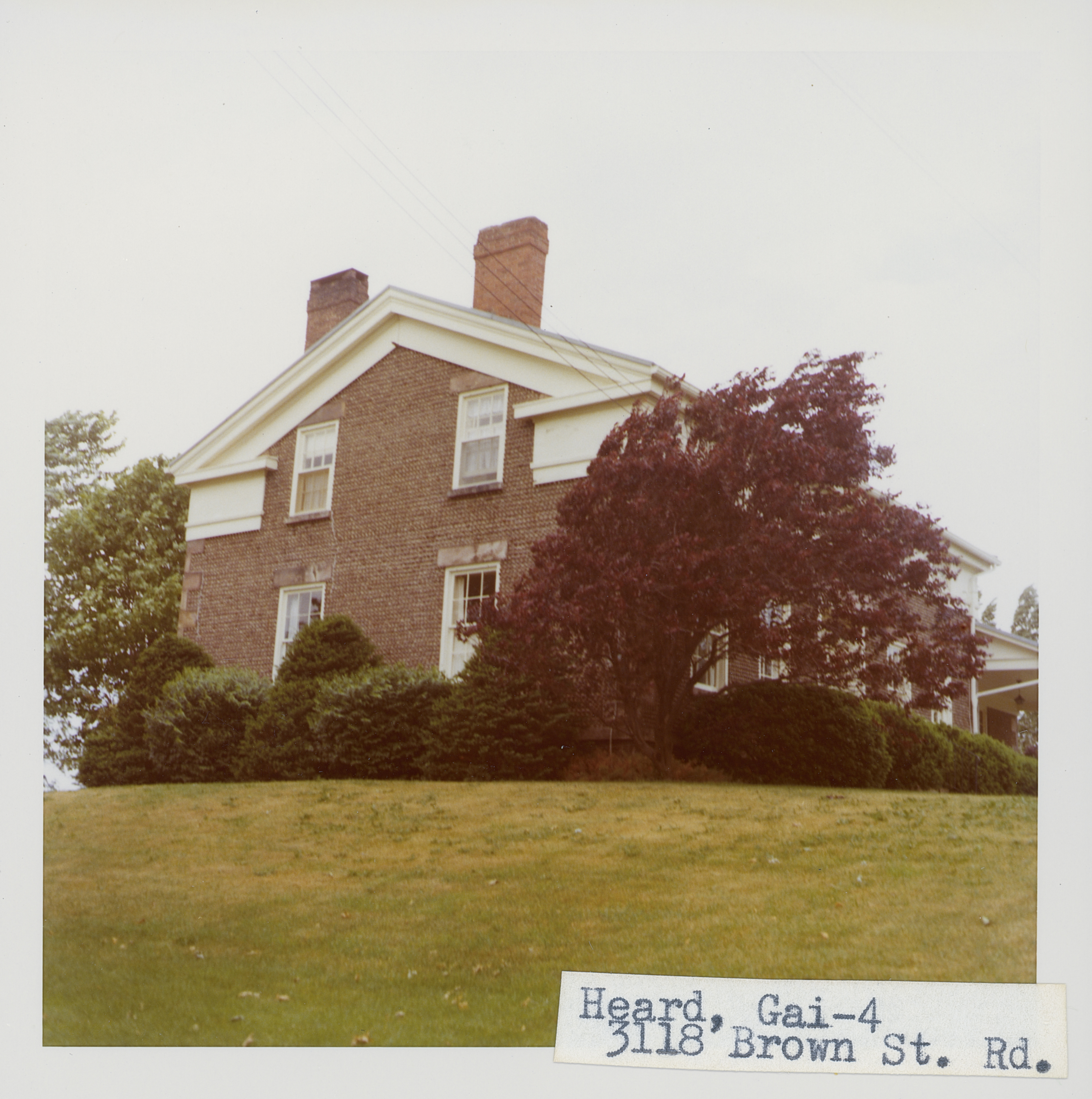
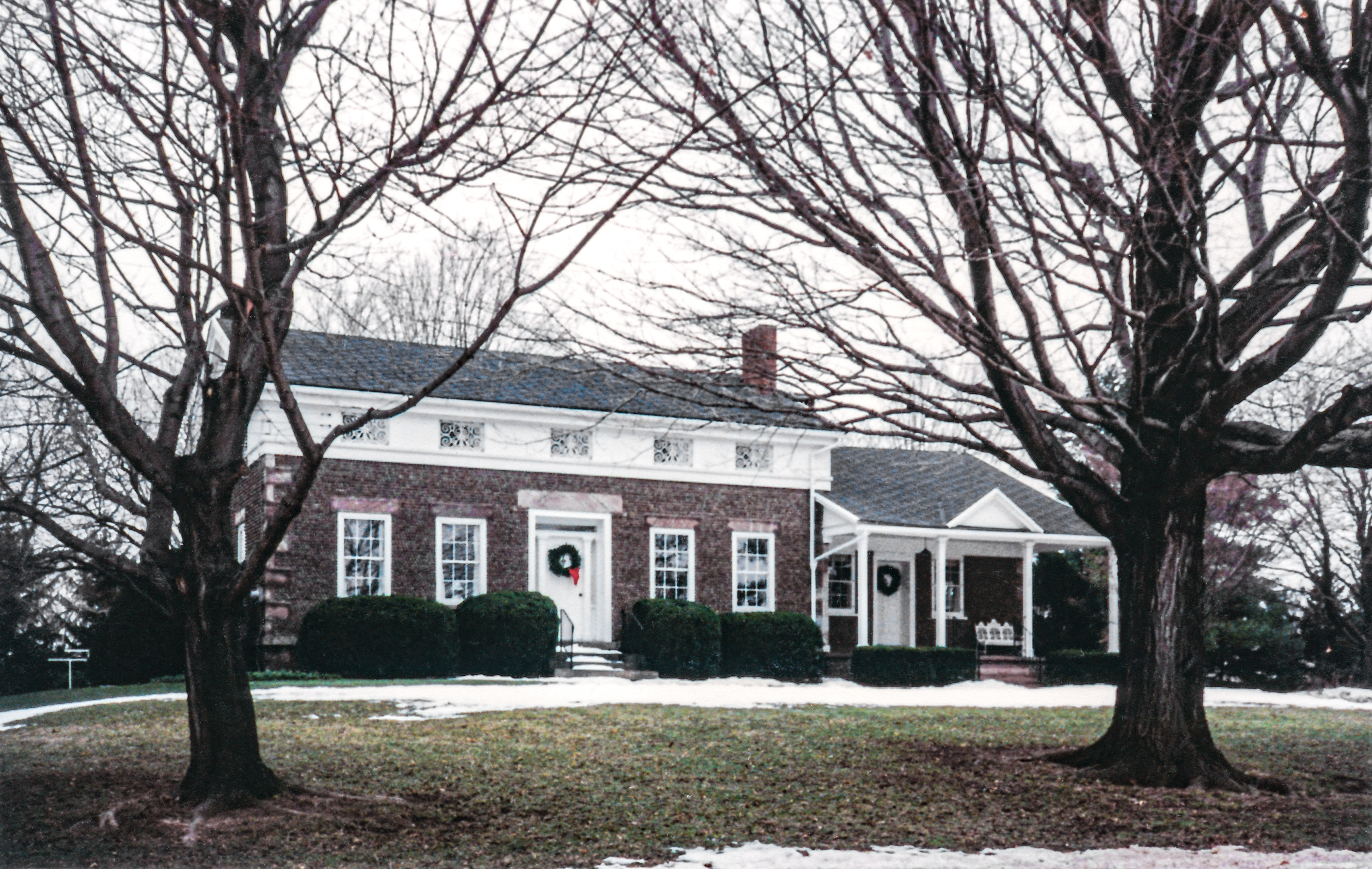
Building date: 1827/8 built frame house, cobblestone addition 1835, 2nd story 1851
Original use: Residence
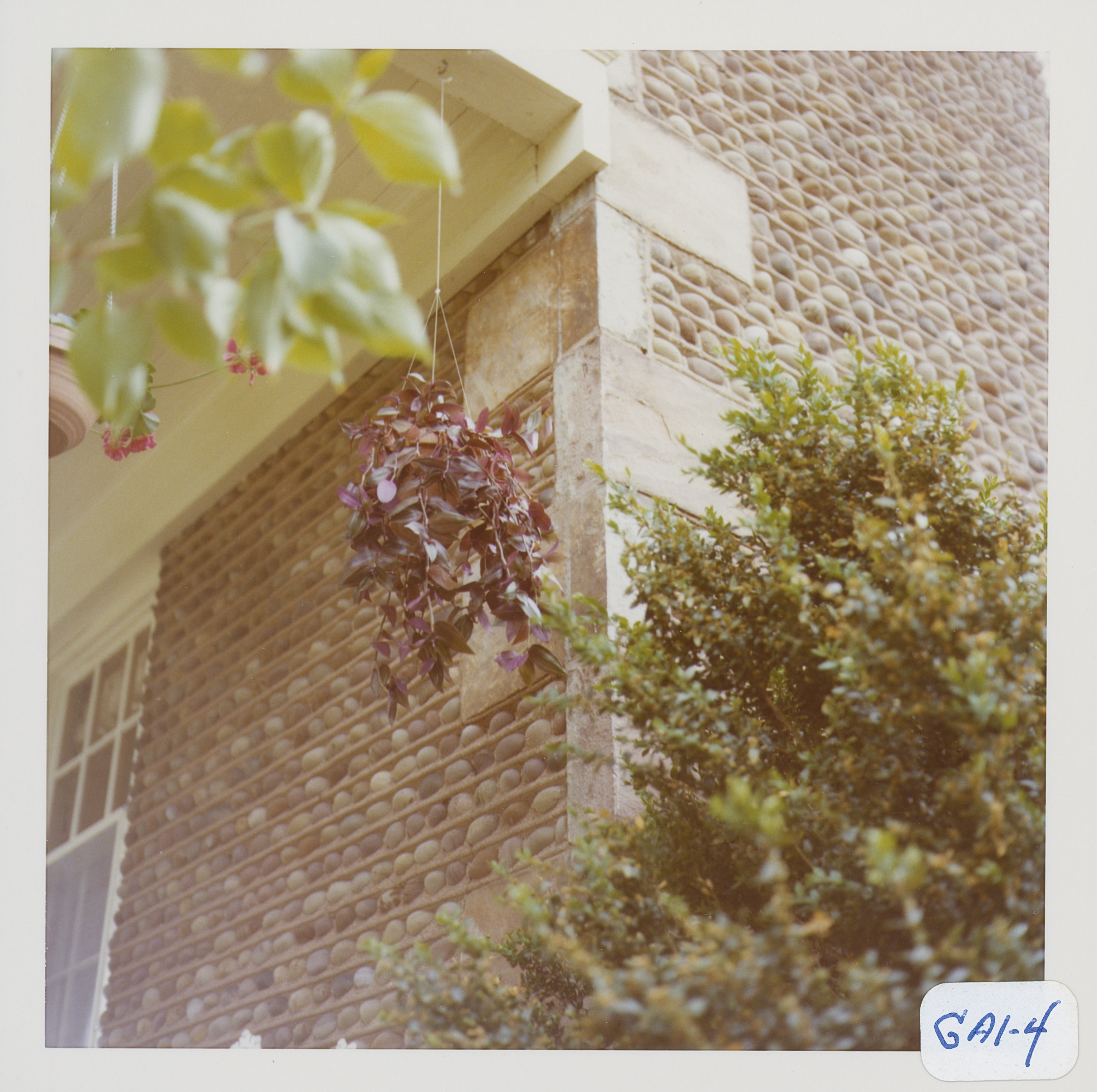
Corner structures: Red sandstone
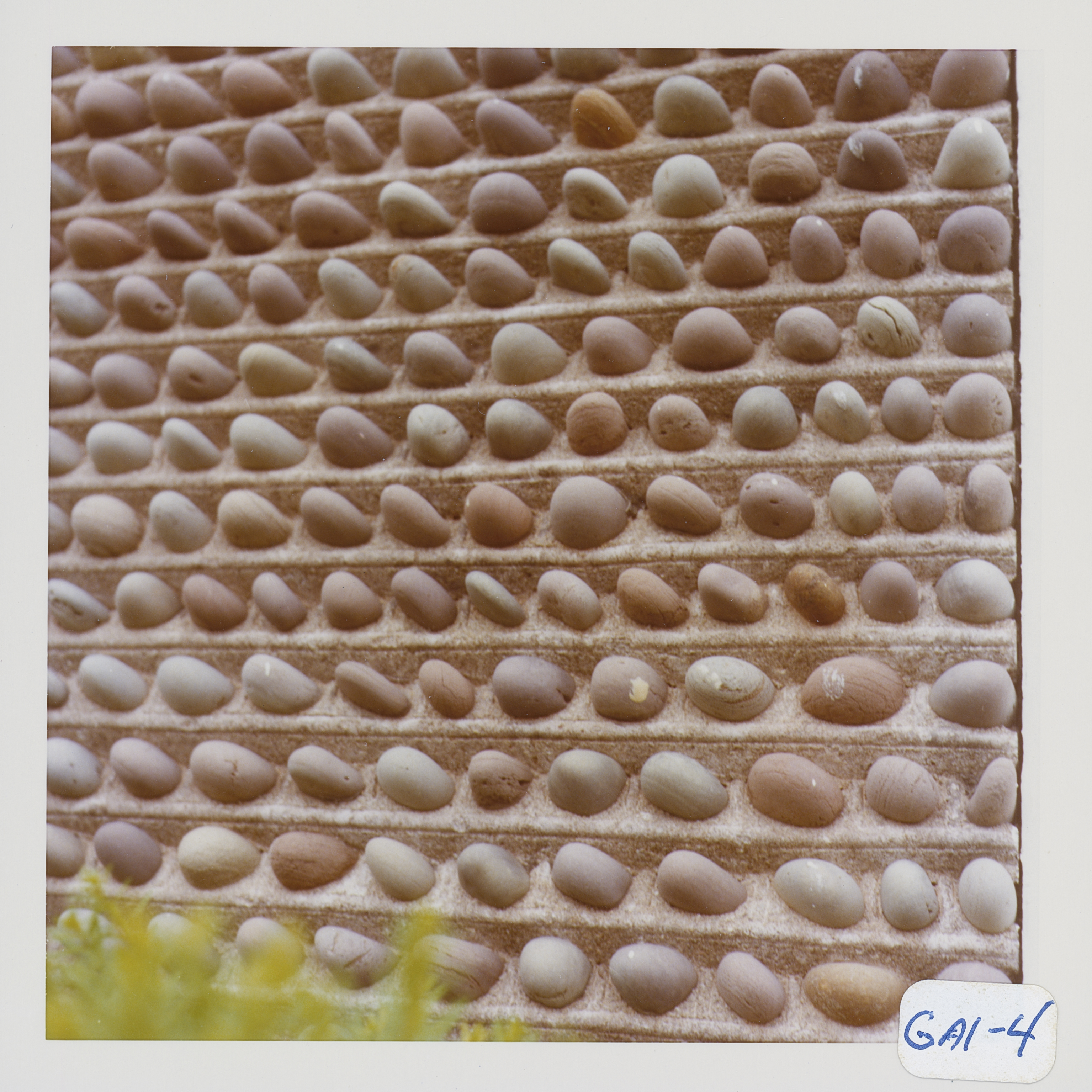
Mortar application and content: Horizontal rounded. Vertical, no embellishment
Types and uses of stones: Small, various colors
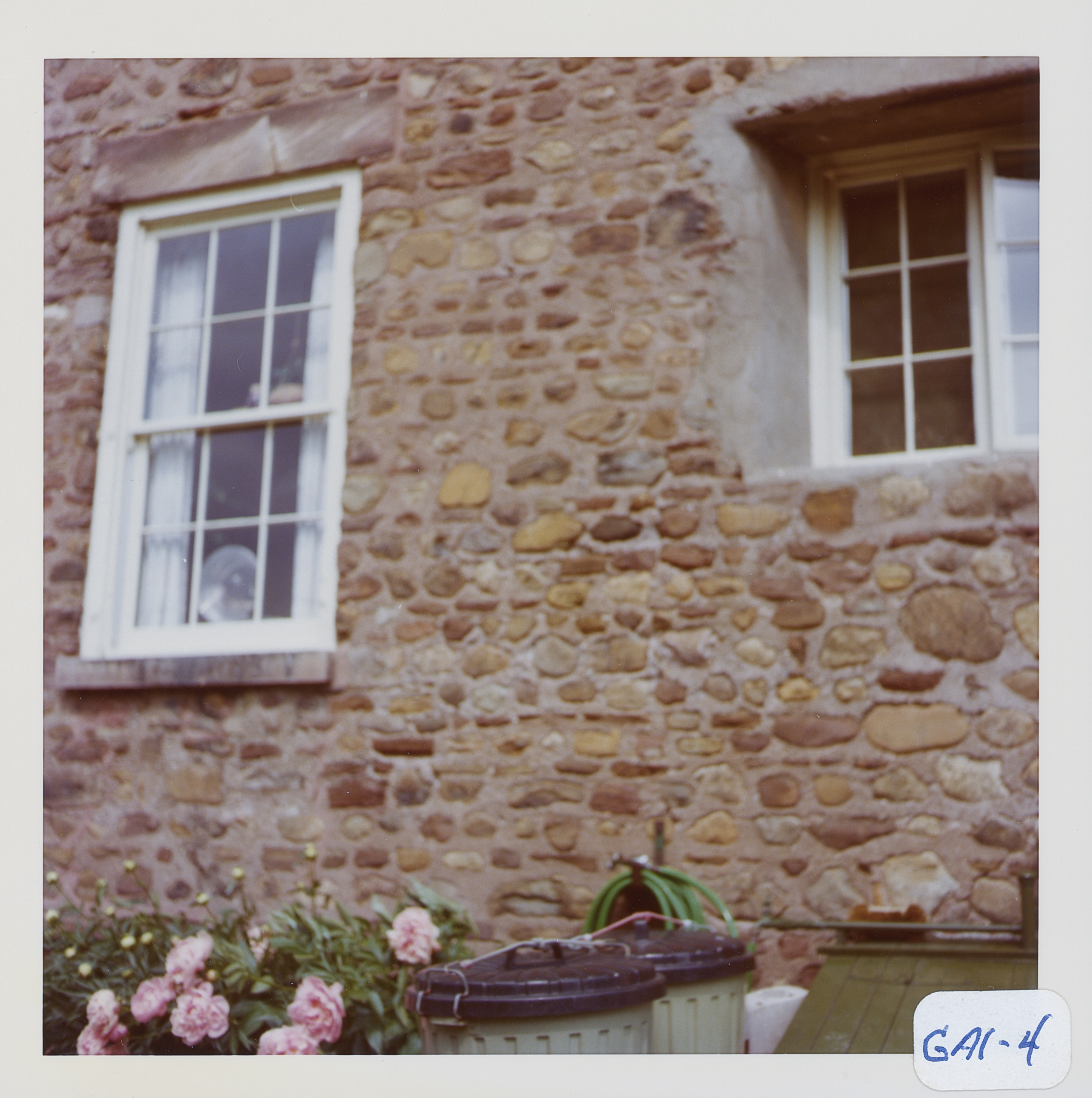
Types and choice of windows: Lintels red stone solid
Structures with similar masonry details: Car-4 Brown
Masons who worked on building: James Thompson
Unique features:
Map views courtesy Google Maps. Address is Google Earth confirmed; 43°15'53.82"N 78°10'41.72"W. Current owner of record, Heard as of the 2019 Tax Roll.
Town of Gaines and Orleans County Maps
Schmidt and Roudabush stated the address as Brown St. Rd., which is currently Brown Rd.
Graystone Farm
Moses Bacon, eldest son of Moses and Rosanna (Rust) Bacon of New Hartford, Conn., took up a tract of land in Gaines township, Orleans County, N. Y., from the Holland Land Purchase, whose headquarters were in Batavia, N. Y., on the other side of Tonawanda Swamp. He sold the south-west part of this tract to his brother Elias, and the south-east to his younger brother Hosea, who first visited it in 1819, when he was nineteen years old. For four years he spent the summers with his brother cutting and sawing timber, and clearing land for planting, but returning to his home in Connecticut to spend the winters with his aging father and unmarried sisters. After 1823, however, he made but one other trip back in 1826 to Connecticut, possibly because he was named an executor of his father's will. He continued to work at his brothers' saw mill at the Five Corners until 1827/8 he received the deed to his property from his brother Moses and built a frame house on this property, cleared more land for farming, and tapped ten acres or more of woodland used as "sugar bush". Two large Iron kettles set in brick "arch" in a lean to at the corn crib and hog house were used to boil the maple sap.
Hosea Bacon married Matilda Ellen Kimball in 1828 and about 1835 he decided to build a stone addition north of the frame house where the older children were born. This was connected to the frame house by a ten foot long wooden, one story passage for the next fifteen years. The stone addition contained a large fireplace, bake oven, a sink of green marble that Hosea Bacon brought from Vermont on a sled in winter, so he could cross the Hudson on the ice. Local fieldstone was used for back walls, and for behind the cobblestone veneer of smoothly rounded lake stones on the east (front) on front and north sides. Quoin stones, stone sills, lintels and water table were of Medina sandstone from Albion quarries, as also stone slabs covering the cistern which under the front porch, and the stone steps. Cobblestones were brought from below the Ridge Road, are larger than those used in the later part of the house, and are laid lengthwise rather than projecting (as in later work). It would appear that this was a rather new idea in masonry, at least in this section. The west side was field stone masonry with brick then protruding about 32 feet to the west.
Due largely to the failure of the Gaines Bank, the subsequent stone addition was delayed until 1851. This replaced the original frame two-story structure, which was now moved to the west and north, doubled in size, and converted into a "sheep shed", with a lean-to at the north end for an icehouse and one ash the south end for a tool shop. No record of the cost of the frame house or the first stone addition has been preserved, but Hosea Bacon recorded certain expenses and data concerning the second and larger stone addition.
Orrin Beach was the carpenter engaged, and was paid in beef, apples, lard, wool, pigs, saleratus [sodium or potassium bicarbonate], wheat, pork, use of horse, use of buggy, and use of oxen and cart to the extent of $20.07; $77.49 in cash; and a note for $44.00. The ledger states "by labour done on house commencing 18 Sept. 1851, resting 17 Dec. 1851: beginning again 12 April 1852, and ending 21 July 1852 $141.56". Orrin Beach prepared his own food over a fire built in the yard as did the mason James Thompson, a "fiery little Englishman" (to quote my quote my grandfather Dausen K. Bacon.)
James Thompson executed the masonry, and was paid in butter, corn, cornmeal, and wheat ...$5.62; paid previously in cash ...$20.00; paid in cash ...$30.30, --making total of $55.92 which account is receipted. 15 Sept. 1851.
This does not include the labor of Hosea Bacon and his sons. The cobblestones for facing the walls were selected on the lake shore north of Kent, where they cost $.50 per load, and hauled by ox-team nearly seven miles: there is no record of the number of loads required, but it is easy to understand why the backs of cobblestone houses were usually plain field stone. After assisting Thompson lay up the cobblestone facing on the east side, Werner Bacon laid up the facing on the south side. He was learning the mason's trade at the time, and at the age of sixteen, laid up the entire south cobblestone wall by himself. It is a beautiful piece of masonry as these things go. He also did some of The plastering downstairs, and, all of it upstairs.
One other item of expense is recorded in Hosea Bacon's ledger, as follows: "Cr. Dunham, by painting 13 pair blinds at 50 cents per pair ...$6.50, & painting "8 shades" at 1/6 a piece ...$1.50: total ...$8.00". This brings the known cost of the "new addition" to $205.48, and does not include cost of some of the materials, nor the labor of Hosea Bacon and his sons Werner and Dauson.
The loom was now placed in the north-west room upstairs, which was specially braced with steel or iron beams in the walls. The original well which "occupied a place "on the porch" of the frame house was now included the basement and a new well was dug some twenty-five feet or more to the west of it, reached by a door from the woodshed or summer kitchen which may have been built about this time. Earth from the cellar excavation was used to build out the slope south and southeast of the house. A straight walk was built from the road halfway to the house, where it joined a semi-circular gravel walk, edged with pieces of broken flagstone, connecting the new entrance with the narrow flagstone covered porch of the older stone portion. A boxwood hedge was planted each side of the walk, from cuttings brought from the old home in Litchfield County Connecticut. It was removed about 1875, when it had become so large that one could not use the walk after a rain without being drenched, as they had neglected to clip it over the years, and it was not the dwarf variety. Cuttings from this boxwood hedge were sent to Werner Bacon, at his request, and planted: at his home in Charlotte, Mich., whence he reported that they were growing well. At that time it was bordered with flowers of a barky type, with flowering shrubs behind them. Flowering trees were planted along the front of the house. The boundary fence along the road was made at the Bacon saw mill and foundry at the Five Corners. It was removed about 1933. When the boxwood at Graystone was taken up and a lawn made in front of the house; flowers and shrubs were taken up and planted along the boundary fence and later, in one end of the vegetable garden to the south, which was originally enclosed on the south and east sides by a four foot stone wall, later crushed for local road work in this area. The flagstone top of the wall, or cap, was used to make stepping stone walks near the property line. It was 1885, according to A. K. Bacon, before any attempt was made to make a clipped lawn in front of the house.
The original smokehouse was a little cobblestone building that stood directly south of the present one.
Cobblestones for the second stone addition were obtained from the lakeshore north of Kent; a team of oxen drawing a load over the "corduroy road" between the lake shore over the marshy ground to the north took a days time. The stones cost the sum of $50.00 per load, when picked up and loaded by the buyer. Two teams were used, and one wagon would be loaded while the other was in transit, so several of the men would stay on the beach, sleeping in blankets, after cooking their meals over a fire there. My grandfather, born in 1835, was 14 or 15 at the time, and used to recall these trips for cobblestones. The men sat and rested while the boys picked up the stones and loaded them. It is not recorded how many loads of stones were drawn to complete the work, but grandfather said they would see several people drawing cobblestones for building purposes, and heard all about the houses, stores, schools, and churches being built of cobblestone "within reasonable hauling distance".
Published References to Cobblestone Houses:
"A Master Builder of the Early 19th Century": article by Marc W. Cole, COUNTRY LIFE, Feb. 1916 --photographs, etc.; Cyrus Wetherill
"A Lost Art" COUNTRY LIFE, June 1917.
Very truly yours, Alan Beverly Burritt, Landscape Architect. Editor's Note: The above is an edited combination of two transcribed letters including hand written edits. One extensive hand written letter to "Tom" was dated 11/24/1953, and the other a condensed, typed version of the former was not dated.
The original "foundation planting" that I can remember, after 1900 that is, was confined to lilies-of-the-valley, some rather barky variety of small leaved English ivy, and plantain lilies (often mis-called "daylilies") plus some vines, - really not what one would consider foundation planting today.
And of course, the shade trees are quite conspicuous by their absence! A very large old "Harvest Apple" tree used to occupy the edge of the south lawn where it met the asparagus bed "half way" - but it went down in a big storm about 1908 I think.
Grandfather, as I recall, put small stones in the driveway about every two or three years that I assisted in gathering from piles in the lane that I helped pick out of the garden and fields. We drew them in a "stone boat" with a team, and although they were in a rather lumpy condition for several weeks, the wagon tires gradually broke them down, and each winter we added "clinkers" from the furnace, and rolled them in, or down, with a roller drawn by a team of horses. I don't think the Hoags, or the family that followed them, ever did much except fill an occasional hole.
When I was about 6 years old, a stone crusher run by an engine and road crew, took all the big stones and bolders that formed the fence or wall between our old orchard, opposite the Roger's place, and the old Rogers' place where the Hoags lived before they came to Greystone (the "Lorengo Rogers'" place). Mr. Rogers had married a Mrs. Ball, whose daughter Ida had married Frank Hoag. I think she still lives in a nursing home in, or near, Albion. I can recall when she was a very handsome woman, and her mother was quite a beauty, my grandmother always said. However, the boys certainly "played hob" with the cobblestone house, as you know. If Art Hoag had lived (he died of blood poisoning form a scratch on his hand when working at what was "Thompson's garage" at the corner of Main and Caroline Sts.) he would never have permitted the younger boys to be so destructive. [Editor's Note: The following sentence was from historical notes written in a Burritt Christmas card.] The hay barn burned, as were other buildings by the half witted Hoag boy now in a State Institution.
The account of building costs I am sending you is one evidently taken from the "big ledger", as it has some information gathered from the larger book, but condensed for ready reference, I should say. It starts in Jan. 1839, after the old part (cobblestone) containing the big kitchen - living room with bed alcove, and kitchen chamber above, had been completed. Some of the items are interesting, namely: On page (28) Dec. 6 1840 Debtor to 1 Turkey $.50. On page (41) 15 Dec credit by Calf $2.00. On page (45) 23 Dec 1841 credit by door hangings $2.66, and again on 4 Jan. 1842 (12) $1.00. I wonder if this was for hanging the doors in the old wooden part, later moved back to the barn yard and used as a sheep barn? - Anyone's guess!
Most interesting, however, on pages (70) and (71),the account with Orrin Beach, the carpenter-builder of the part containing parlor, dining room, pantry and the two bedrooms downstairs, and the main ones upstairs. On page (47) note common labor at $.50 per day, and some where he paid his daughter $.75 per day, I've been told for spinning wool and flax. Boy! - she was a sure 'nuff white-collar worker!!
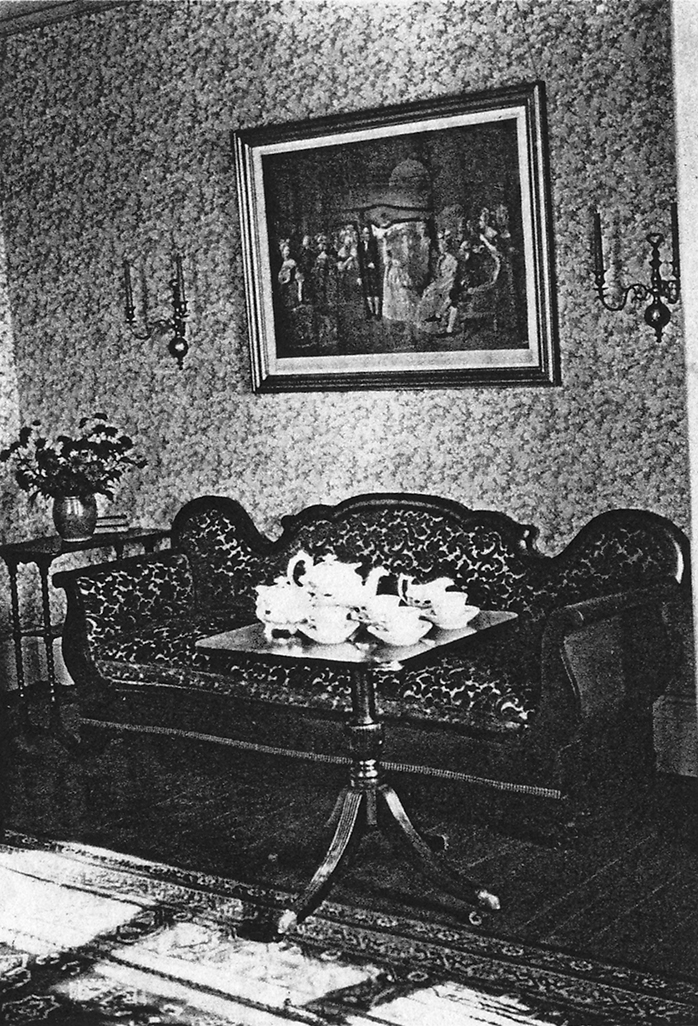
Xerographic copies of circa 1915 Greystone parlor photograph and glazed chintz fabric sample, courtesy Al Burritt.

I'm enclosing a picture of the "parlor" as I first knew it with the colored engraving of "Franklin at the Court of France" above the sofa, and my great-aunt mother Bacon's wedding china (1828) shown in the tea table. Alas, I have only the china now, a wedding gift from my mother, my uncles, and cousins Nellie and Edith Winch. We have found three saucers, two cups and an additional plate in the past 25 years that match it.
We found a piece of the original glazed chintz used for bed curtains and bed cover first in the old wooden part of the house ... and finally used for the bed alcove the old kitchen-living room of the first cobblestone part. I am enclosing a xerographic print of this fabric. It is a French print of about 1840 I'm told. The original was blue-green on white; the floral panel and staggered pillars alternated for the entire width of the fabric. I just thought that perhaps you might like some idea of the original "store-bought" fabics used, as the majority were just homespun cotton, line and woolen fabrics, with an occasional cotton calico print from India, and none of the latter survived. Mother made us two sets of table mats from pieces of the original tablecloths her grand-mother wove, which we use "for best".
Sincerely, Alan [Burritt]
From a letter written to "Tom" dated 3/29/1955.
1894 photograph courtesy Al Burritt.

The front of house is shown with the original kitchen wing before porch was added about 1901, with flagstone floor that covers the cistern, and stone steps all across the front and around the north ends.
[Cropped from photograph on the right.] Also, "old Prince" hitched up fo a trip to town. There was wooden mounting block there, in case you rode horseback, made from a 3 ½ foot sycamore log (I'm told). The old cedar hitching post and cellar doors were there, and the small windows (of "Greek Key" design) in the cornice above the porch, - one showing through the top of the laburnum tree, - and the other hidden by vines, morning glories seem to be planted in a box standing on one of the long stone steps, which I think are still there under the porch (we used to look through the lattice and see them when I was small).
My earliest memories do not include the picket fence running from the road to the corner of the porch, but I recall a wire fence of a later date there, covered by climbing roses. In 1905 there was no part remaining of the stump of the old maple tree shown in the lower left part of the picture, but the old stone horse block and stone steps to it existed until removed by the Hoag clan. They also removed the iron and plank fence so the boys could park their cars all over the front lawn. Well, such is life.
Yours, Al Burritt
"The Cobblestone Houses of Upstate New York", compiled by Dorothy Wells Pease. Research done in collaboration with Hazed B. Jeffery, supplemented with material furnished by Carl F. Schmidt. Reference the ninth paragraph on page 7.
Right side elevation sketch of the cobblestone house.
"Cobblestone Buildings of Orleans County, N. Y.", A Local History, page 27, by Delia Robinson, Edited by Evelyn Lyman and William Nestle. Jointly published by The Cobblestone Society and The Orleans County Historical Association, December 1996.
Genesee Country Historical Federation Cobblestone Tour, 10/10/1966 - Editor's Note: Detailed historical narrative.
The Cobblestone Society & Museum Tours:
Bacon Heard House 1st Cobblestone Tour 06/10/1961, 2nd Annual 06/9/1962, Cobblestone Society Tour 06/01/1991
- "Cobblestone Masonry", 1966, Carl Schmidt: Name reference, Bacon - Heard House
- Page 123
- "Cobblestone Landmarks of New York State", 1978, by Olaf William Shelgren, Jr., Cary Lattin, and Robert W. Frasch, Photographs by Gerda Peterich: Name reference, Bacon House
- Page 64
- "The Era of Cobblestone Architecture", unpublished manuscript 1972. To access the manuscript content about this structure, see 96. Orleans County, Bacon-Heard House.






¹ Lanson House photograph courtesy Library of Congress. Data Page
² Photography courtesy Gerda Peterich. Cobblestone Museum.
³ Image courtesy Cobblestone Museum.
4 Photography courtesy Martin and Sheila Wolfish.
5 Photography courtesy Richard Palmer.
